1
Understand the environment
Stakeholder listening, context analysis, operational constraints, critical assets and dependencies.

Approach
Reducing risk without disconnecting architecture from real operational constraints or business priorities.
IT/OT Architecture
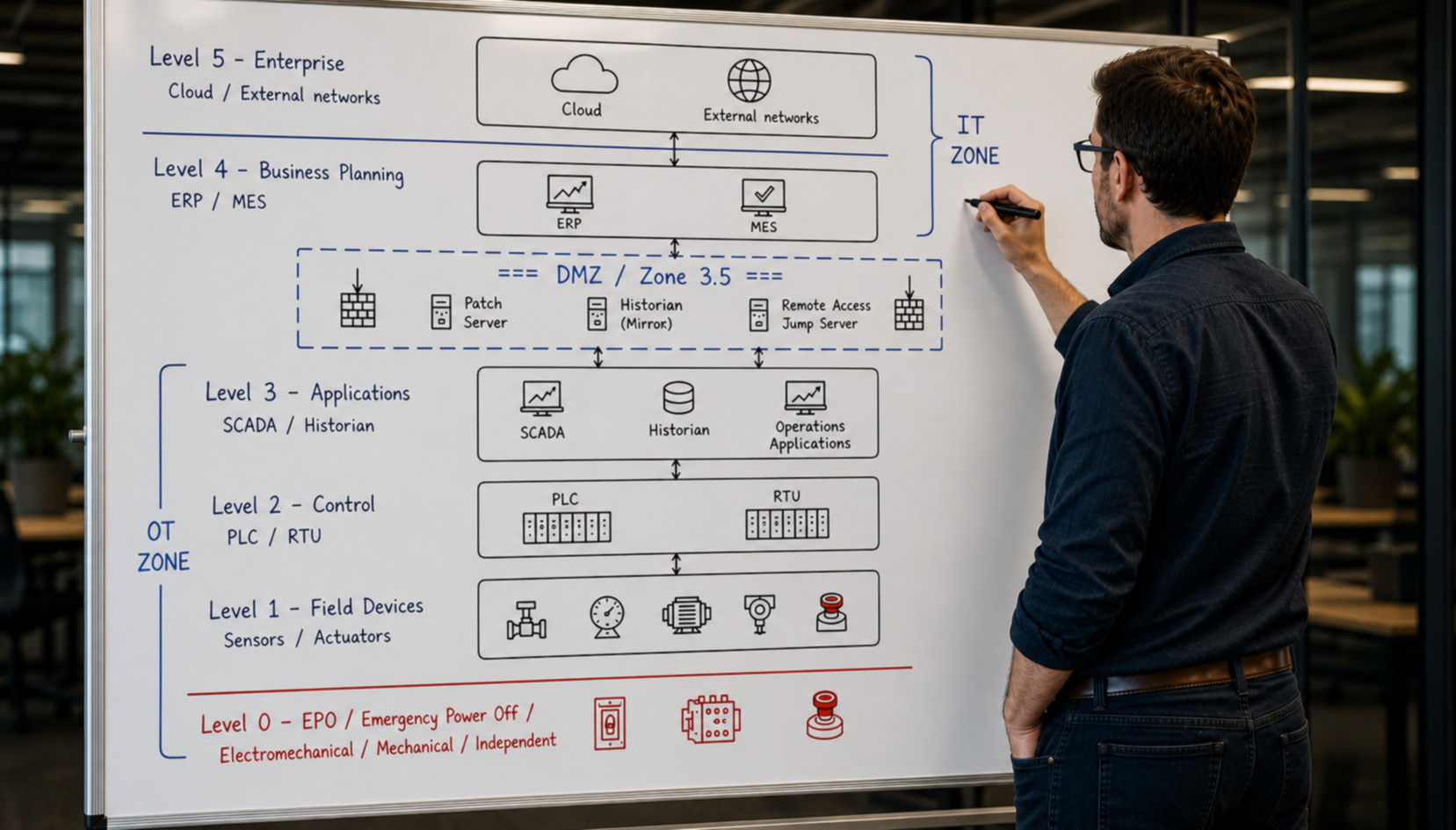
The Purdue Model structures the levels of an IT/OT architecture — from the electromechanical layer (EPO) up to enterprise systems and the cloud, with a demilitarized zone (DMZ) as the security boundary between OT and IT.
Stakeholder listening, context analysis, operational constraints, critical assets and dependencies.
Connecting business needs, technical limits, risks, budgets and field feasibility.
Defining segmented, secure, maintainable, documented and scalable architectures.
Team support, targeted training, knowledge transfer and clear, usable, audit-ready documentation.
Frameworks
Standards and models should not be applied as simple checklists. RĒSUNIX adapts them to real constraints: real-time performance, availability, legacy systems, maintenance, supplier access, segmentation, governance and operational continuity. The frameworks listed here are the most common — other sector-specific, regulatory or organization-specific frameworks may apply depending on the mandate.

Publications for cybersecurity and risk management, including SP 800-82 for OT.

Structuring levels, zones, conduits and flows between IT and OT environments.

Best practices for securing industrial automation and control systems.

Canadian guidance applicable to risk, controls, wireless, telecommunications and sensitive systems.